Sunshine 811: Call Before You Dig in Martin County
Before you dig anywhere in Stuart — a fence post, a landscaping project, a new footing — Florida law points to one specific service. Here's what Sunshine 811 actually requires.
ReadStuart, FL guide
Sizing a dumpster wrong in either direction costs you — too small means a second delivery, too big means paying for space you never fill. Here's how to get it right the first time in Stuart.
The fastest way to size a dumpster wrong is to guess based on how big your house or lot looks. The container that's right for your job depends on what's coming out of it — a garage full of light, bulky boxes fills a container by volume long before it fills by weight, while a stack of roof tiles or a pile of demolition debris does the opposite, hitting the weight limit while the box still looks half-empty. Getting the material type right before you book is the single biggest factor in sizing correctly, whether your project sits on a tight in-town Stuart lot or a wider Martin County driveway.
Every roll-off container has two limits: how much it can physically hold, and how much weight it's rated to carry once it's on the truck. Light, bulky debris — furniture, cardboard, old carpet, general household junk — usually runs out of room before it runs out of weight allowance. Dense debris — roofing material, concrete, packed soil, wet drywall — tends to do the opposite. Knowing which category your project falls into, before the truck ever leaves our yard, is what keeps you from either paying for empty space or getting stuck mid-job with a container that's already maxed out on weight.
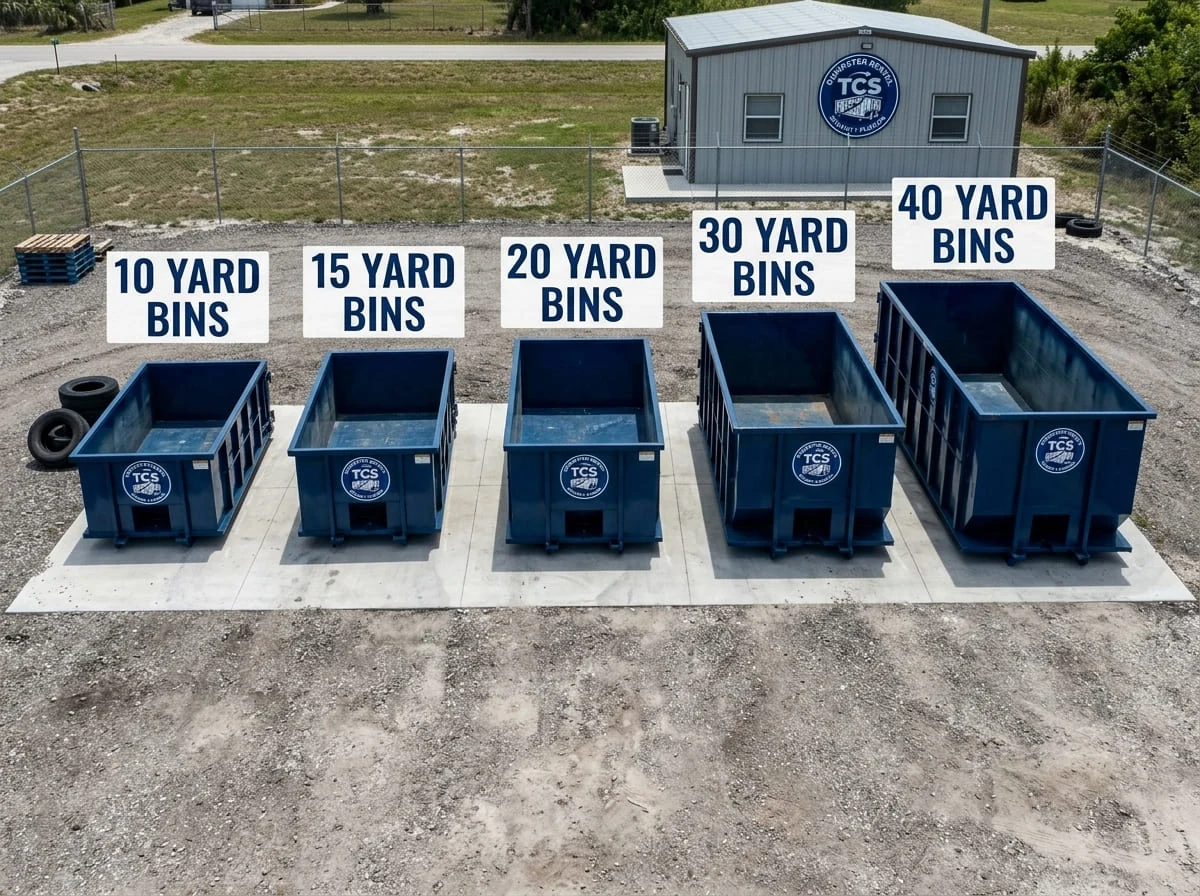
Our five container sizes cover everything from a single-room cleanout to a full new-construction build. A 10 yard suits small cleanouts, roofing material off a modest roof, and tight driveways where space is at a premium. A 15 yard is the sweet spot for flooring jobs, a single bathroom or kitchen update, or a multi-room cleanout. A 20 yard covers medium remodels, most roofing jobs, and light construction. A 30 yard is built for whole-home projects and office cleanouts, and our largest option, the 40 yard, is sized for large builds and commercial or industrial jobs.
| Size | Dimensions | Capacity | Weight included | Best for |
|---|---|---|---|---|
| 10 Yard Dumpster | 14 ft long × 7.5 ft wide × 3.5 ft high | 50–70 bags | 1–2 tons | Small cleanouts, roofing shingles, tight driveways. |
| 15 Yard Dumpster | 16 ft long × 7.5 ft wide × 4.5 ft high | 80–100 bags | 2–3 tons | Flooring, bathroom or kitchen updates, multi-room cleanouts. |
| 20 Yard Dumpster | 22 ft long × 7.5 ft wide × 4.5 ft high | 110–130 bags | 3–4 tons | Medium remodels, roofing jobs, light construction. |
| 30 Yard Dumpster | 22 ft long × 7.5 ft wide × 6 ft high | 170–190 bags | 4–5 tons | Whole-home projects, office cleanouts. |
| 40 Yard Dumpster | 22 ft long × 7.5 ft wide × 8 ft high | 230–250 bags | 5–6 tons | Large builds, commercial or industrial jobs. |
A garage or lanai cleanout in a typical Stuart home usually fits a 10 or 15 yard. A single bathroom or kitchen remodel tends to land in the same range, occasionally stepping up to a 20 yard if cabinetry, tile and flooring are all coming out together. A full reroof, a whole-home renovation, or a waterfront property cleanout more often calls for a 20 or 30 yard. New construction across Martin County typically needs a 30 or 40 yard, frequently with more than one scheduled swap-out across the build.
Most Stuart and Martin County driveways handle any size in our lineup without issue, but tighter in-town lots near the historic downtown core and some older waterfront streets sometimes call for a smaller container or a curbside placement instead of a driveway drop. If a container needs to sit in a public right-of-way rather than on your own property, check with the City of Stuart or Martin County first — placement rules can apply there. Tell us your address and where you'd like the container to sit when you call, and we'll confirm it fits before the truck ever shows up.
If you're genuinely unsure between two sizes, the safer call is usually the larger one — a partially filled container costs less hassle than a mid-project swap-out that stalls your timeline. That said, we'd rather talk you into the right size than the biggest one; if a smaller container is the honest answer for your job, we'll say so.
Call (772) 266-7760 and describe what you're clearing — the room count, the material, and roughly how much of it there is. We'll size the container based on that, not a guess, and get it delivered on your timeline across Stuart and every corner of Martin County.
Talk to a real person
Call and describe the job. Flat-rate pricing, a sized container, and a delivery time on the same call.
Mon–Sat 7:00am – 7:00pm
From this guide
A 15 yard is the most common fit for a multi-room cleanout, flooring job, or a single bathroom or kitchen update. Smaller garage or lanai cleanouts often fit a 10 yard.
Generally yes — a partially filled larger container is less hassle than running out of room mid-project. Tell us the details when you call and we'll help you land on the right size rather than always defaulting to the biggest option.
Both, but dense materials like roofing debris, concrete and wet drywall usually hit the weight limit before the container looks full, while bulky light debris like furniture usually runs out of room first. Tell us the material type so we can size around whichever limit applies.
Most Stuart driveways handle our full size range. Tighter in-town lots near the historic downtown core sometimes call for a smaller container or curbside placement — tell us your address and we'll confirm before delivery.
Keep reading
Before you dig anywhere in Stuart — a fence post, a landscaping project, a new footing — Florida law points to one specific service. Here's what Sunshine 811 actually requires.
ReadIf you've heard of PaintCare paint drop-off programs elsewhere, know this first: Florida isn't one of the states that has one. Here's where leftover paint and HHW actually belong in Martin County.
ReadRoofing material is dense, and weight — not volume — is what actually limits a roofing dumpster. Here's how to size a tear-off correctly the first time.
Read